
Real growth is not forced. It is tended.
Once the seedling is in the ground, the outlook changes.
You stop asking: how do I make this happen? And you start asking: how do I care for the conditions that make growth possible?
This is where most people get confused. They treat integration as a mindset, staying positive, trying harder, pushing through. But in a real growth process, integration is relational. It is how the different parts of your inner system stop pulling in opposite directions and begin to work together. It is how the whole becomes coherent.
This is Part 3 of a four-part March series on sustainable change, using the metaphor of growing a tomato plant. If you are landing here first, start with Part 1 — the arc builds progressively and this post picks up where Parts 1 and 2 left off.
Seeds come from death
Before we talk about tending, there is something worth naming about what made the planting possible in the first place.
New life requires breakdown. Seeds come from death. Sometimes what felt like falling apart in you, the ending of a role, the dissolving of an old story, the quiet grief of outgrowing something, was not a crisis. It was composting. The structure that had to die so the seed could form.
This is honoring what had to end so the new could root.
When growth needs support
Anyone who has grown tomato plants knows they grow aggressively. They sprawl. Left unattended, the vines crawl along the ground, tangled, prone to rot, producing too much fruit with too little sweetness. They snap under their own weight.
This is the perfect mirror for human transformation. Growth is not automatically good simply because it is happening. Unheld growth, growth without nurture or care, leads to collapse. More output does not mean more coherence. More doing does not mean more alignment.
In practical terms, this is the Integrate phase of the Trinity Mystic Healing Journey: returning to the work of honoring what is growing, acknowledging what still weighs on the system, and creating the conditions for inner cooperation. Not force. Not control. Conscious, caring attention.
The conditions: water, sun, soil, and support
The tomato plant does not grow through willpower. It grows because four conditions are consistently met. These are not decorative metaphors. They are a practical map for identity-level transformation.
Water is emotional nourishment and steady attention. In nature, water is the solvent that allows the plant to absorb what the soil offers. Without it, the system becomes brittle. A dry plant does not push through a harsh environment. It cracks.
In the human system, water looks like honest emotional acknowledgment. Rest that is not earned through suffering. Consistent self-contact. Supportive inputs: what you read, what you listen to, what you rehearse internally. When you are emotionally dry, your identity container becomes a harsh place to live in. Growth becomes a grind rather than an unfolding.
Sun is repetition and spiritual reinforcement. Across many traditions the sun represents the True Self — the part of you that remains radiant regardless of the clouds passing through. In Jungian thought it is the archetype of wholeness. The sun does not force the plant to grow. It simply shows up consistently and the plant turns toward it.
In your transformation, sun looks like small aligned actions that embody your True Self, repeated with patience. Returning after setbacks without shame. Choosing identity conditions that feel honest again and again, not because you have perfected anything, but because you keep orienting toward what is aligned in you. The True Self does not need to be created. It needs to be turned toward, the way a plant turns toward light. Sun is how the subconscious gathers proof that this new direction is safe. Not through intensity. Through continuity.
Soil is the identity container, the foundation and the pharmacy. Healthy soil is not solid. It is full of tiny pockets of air. If the container is still compacted by old beliefs and inherited rules, you can add all the water and sun available and the roots will still struggle. The plant can even drown.
Soil work in the Integrate phase looks like re-patterning beliefs at the identity level. Clarifying what is actually true versus what was inherited. Updating the internal story without shaming the past. The goal is not a perfect story. The goal is a breathable container, one that decomposes what is no longer needed and turns it into nutrients for what is coming next.
Support is the structure that prevents collapse. I chose a tomato plant for this series because of one specific truth: it needs a cage. Not because it is weak, but because it is designed to grow and carry weight, and unsupported growth leads to collapse or rot.
Support in a human system looks like boundaries held before resentment builds. Rhythms that create containment. Simple structures that reduce decision fatigue. Environments that lower emotional leakage. Support is what allows the new identity to carry its own weight without being crushed by the old.
Pruning and weeding: the authenticity work
Caring for conditions is not only about what you add. It is also about what you remove. And timing matters here — pruning and weeding are developmental practices. They belong in this phase, while the plant is still forming. By harvest it is too late. The fruit that grows unchecked will be whatever the whole tangled system produced, not what you actually intended.
As a tomato plant grows, two things happen alongside the fruit: suckers appear and weeds move in. Suckers are shoots that look like growth but divert energy away from what matters. Weeds are what sprout automatically in fertile ground, not because something went wrong, but because that is what dormant seeds do when conditions finally improve.
The same is true in human growth. As the inner environment becomes more nourishing, things that were previously dormant will surface. Some of it is new life. Some of it is old patterns reasserting themselves. Some of it was never yours to begin with: inherited beliefs, comparison, urgency, standards absorbed from other people’s lives that have been quietly draining your energy.
Pruning is authenticity work. It is noticing what is costing more than it is giving and making a clean, honest cut. A commitment past its genuine end. A role you are still performing out of habit. A way of relating to yourself that belonged to an older version of your life. Pruning is not punishment. It is how you redirect energy toward what is actually true.
Weeding is the practice of catching what grows automatically and asking whether it is yours. Not to shame it, but to remove it. Comparison that sneaks in when progress is quiet. Urgency that belongs to someone else’s timeline. A story about what you should be doing that came from someone else’s garden entirely.
Both practices serve the same purpose: keeping the inner environment clean so what is genuinely growing has room to become what it actually is. Next week we will look at what happens when that growth reaches the harvest stage — and why even well-tended gardens require a different kind of attention then.
Harmonizing parts: tending what is inside you
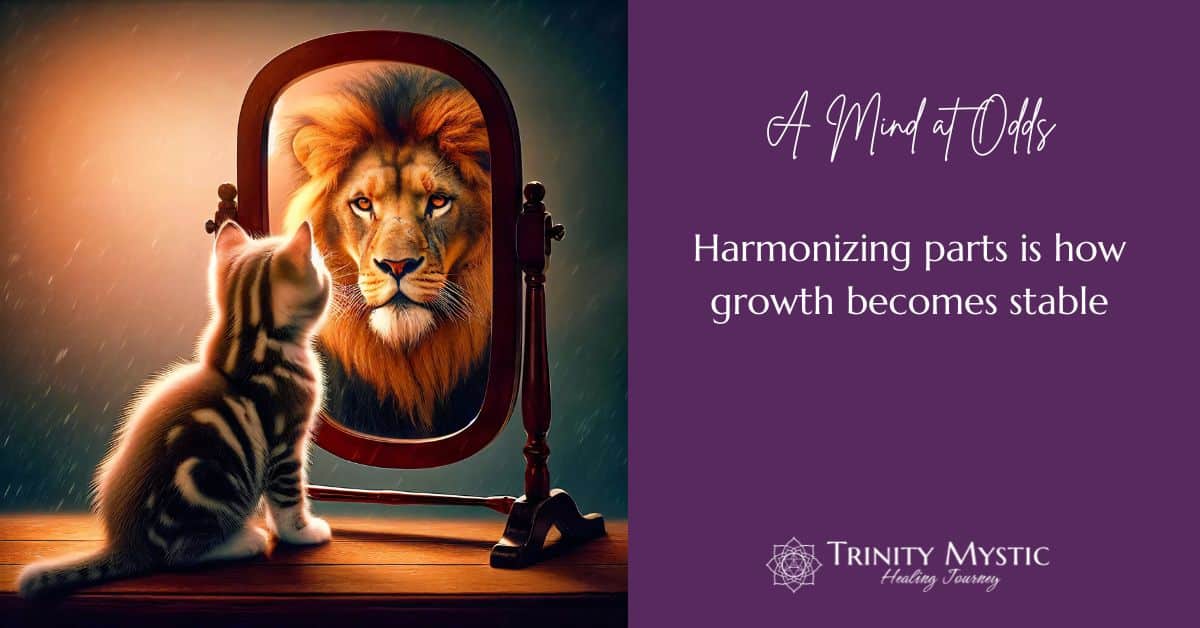
Most humans are not a single, unified voice inside. There are parts that want change and parts that are afraid of what change will cost. Parts that are ambitious and parts that are exhausted. Parts that have been carrying weight for a very long time.
The work of harmonizing these parts begins with awareness, with noticing what is actually present. From there, it moves into honoring what each part has been carrying. Understanding what it actually needs. Creating enough inner safety that cooperation becomes possible. And finally, finding a genuine agreement the whole system can live with.
This is how we move toward the True Self, not by silencing the parts that resist, but by bringing them into a conversation the True Self can lead.
Integration is not choosing one voice and calling it truth. It is building inner harmony, making room for the full ecosystem without letting any one part run the whole garden unquestioned.
Here is the key distinction: a protective part is trying to prevent pain. It is not trying to prevent your growth. When you approach it with curiosity rather than override, it often softens. When you push past it, it escalates. This is why trying harder can make things worse. It increases inner conflict rather than resolving it.
Harmonizing parts is quiet work. It sounds like: what are you afraid would happen if I actually changed? What pain are you protecting me from? These questions shift the entire relationship from combat to dialogue.
The Achiever distortion
Many of my clients are what I call Achievers. They are capable, driven, and deeply committed to growth. They show up. They do the work. They often have impressive external results to show for it.
And yet, in the Integrate phase, this same strength can become a source of friction. The Achiever can mistake output for alignment, force for commitment, and overproduction for success. Spiritual growth becomes another scoreboard. Integration becomes an optimization project. The new identity gets performed loudly before it has had time to stabilize quietly.
This is not a character flaw. It is a strategy that worked well in other contexts. But tomato plants teach a different truth here. Overproduction reduces quality. More fruit does not automatically mean sweeter fruit. More doing does not automatically mean more coherence.
If you notice yourself piling on new habits, new practices, new commitments all at once, that is worth pausing to examine. Integration asks for a different kind of strength. Not force. Care.
What integration actually looks like when it is working
Integration is not always dramatic. It accumulates quietly, in ways that are easy to miss if you are still measuring by intensity.
You may notice less inner conflict day to day. Faster repair after something hard. Choices that feel simpler because you are not fighting yourself to make them. The ability to hold complexity without collapsing. Moments where you care for yourself without turning it into a performance.
This is the change that holds. Not the dramatic shift. The quiet becoming normal.
Three practices for the Integrate phase
1. Check your conditions. Start with the basics of self-care and honest attention. Ask:
Am I emotionally nourished right now, or running dry?
Am I getting enough rest, self-contact, and supportive input?
Am I taking small actions that feel aligned, or have I gone quiet on myself?
Is the story I am telling about this change true, or inherited?
Do I have enough structure and support around me to hold what is growing?
Pick one condition that feels neglected. Give it your honest attention this week. This is not a performance. It is care.
2. Notice what is resisting. Start with what you can actually observe.
Are you feeling resistance when you think about changing something?
Hearing negative self-talk?
Noticing avoidance, distraction, or suddenly being very busy?
Those responses are usually protecting something. They are not sabotage. They are signals. Getting curious about what they are guarding is the beginning of real integration: awareness, then honoring what the part has been carrying, then understanding what it needs, then creating enough safety for something new to become possible.
3. Choose quality over output. If you notice yourself piling on new habits, commitments, or practices all at once, simplify. Choose the one action that builds coherence and self-trust. Not the one that proves effort.
Closing reflection
Growth does not have to be a fight. When the conditions are right, the plant wants to grow. Your only job is to stay in the garden.
Next week is the final post in this series — the Align phase, where we talk about stewardship, fruit quality, and what it means to live from the new container rather than perform it.
If this series is landing for you, subscribe below to receive the final post as it publishes. One post a week, written to help you understand your own process more clearly.
And if you find yourself knowing what you want but unable to get all of you moving in the same direction, that is the Integrate session. We listen to what is pulling against the change, understand what it needs, and begin to build the inner agreement that makes follow-through feel possible.